When Work Hurts in Silence, burnout at work, emotional exhaustion. How many wake up day after day, all year long, with the same feeling, the same thought?
Is it an illness?
Is it depression?
Was it because I argued with my coworkers?
My boss?
Me?
There is a kind of exhaustion that doesn’t show from the outside.
It makes no noise. It doesn’t complain.
It keeps going.
Work hurts in silence when the body gets up,
but something inside stays seated.
When showing up becomes automatic
and enthusiasm begins to feel like a distant memory.
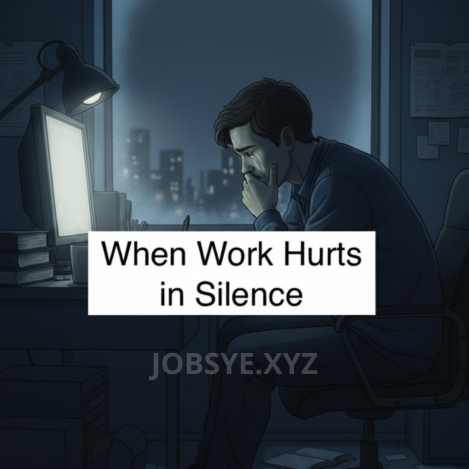
For those who are tired but still showing up.
It hurts when we normalize being drained.
When rest feels like failure.
When we learn to silence what weighs on us
so as not to inconvenience, so as not to appear weak.
No one taught us how to listen to this pain.
We were taught to endure it.
When productivity continues, but something inside withdraws.
And yet, feeling it is not a mistake.
It is a signal.
A way of saying: this is not how I want to live.
This text does not come to demand answers.
It comes to accompany.
To tell you that you are not alone,
that you are not exaggerating,
that your exhaustion makes sense.
There is a kind of burnout that does not announce itself through visible crises.
It shows up as emotional exhaustion, as a persistent fatigue that lingers even on “normal” days.
It does not always prevent us from working; on the contrary, it often coexists with high functionality.
Within productivity culture, this exhaustion is usually interpreted as something personal: a lack of discipline, focus, or resilience.
It is rarely recognized as part of a work culture that demands constant availability, continuous performance, and nonstop adaptation.
Family, partners, children—even pets—are affected.
These days, many of us live under work demands that few can endure: no vacations, long hours, no fixed schedules.
And weekends? Some of us no longer know what a day off is. And when we do, it is often filled with more tasks that still leave us feeling unsatisfied.
This silent erosion affects mental health without asking permission.
It seeps into how we rest, how we relate to others, and into the difficulty of disconnecting without guilt.
Work stops being just an activity and begins to occupy the space of life itself.
Talking about chronic stress, high-functioning anxiety, or collective fatigue is not an exaggeration.
It is an attempt to name the human cost of work when the balance between life and work breaks down—yet we are still expected to carry on as if nothing were wrong.

0 comentarios